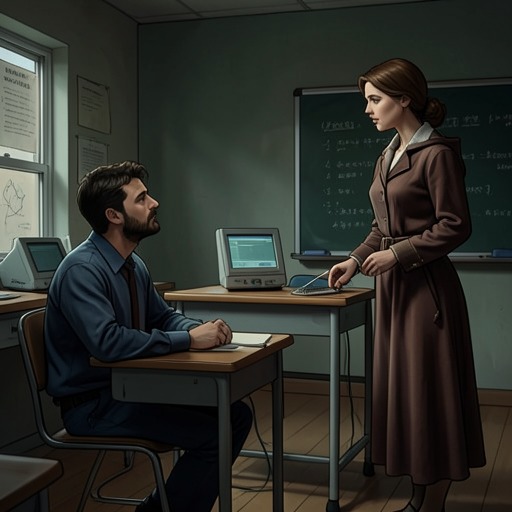
Connell’s anxiety and emotional distress
Normal PeopleConnell’s anxiety and emotional distress are not confined to moments of visible panic: they structure his sense of himself among other people. At Trinity College Dublin, the confidence of his classmates makes him feel intellectually and socially inferior; away from the reputation that carried him through school, he experiences himself as nearly invisible. His longing for connection repeatedly collides with fear of exposure, and the resulting silence and withdrawal contribute to hurtful choices. Later, he can identify his anxiety as part of what shaped his behavior toward Marianne, though that recognition does not make its physical force disappear.
College and the loss of a social identity
At Trinity College Dublin, Connell initially reads his classmates’ fluent opinions as evidence that they are far more intellectually capable than he is. In seminars they debate passionately, while he struggles to form views or express them forcefully. The apparent gap narrows when he realizes that many classmates have not done the reading: their confidence is not proof that they understand more than he does. Still, the discovery does not make him feel at home. He thinks they move through the world differently, and doubts that they will understand him or try to.
The mismatch is sharpened by the rituals of campus life. Connell sees classmates carry the same size MacBook and recognizes how easily they voice opinions without fearing that they will appear ignorant or conceited. By contrast, he spends his spare time reading assigned texts, novels, and literary criticism, often alone in the library or over lunch. Reading can move him deeply, but this private resource does not automatically give him the ease his peers display in conversation.
The physical details of his life reinforce his sense of being out of place. He shares a box room near college with his flatmate Niall, their two single beds pushed against opposite walls; damp and cold make Connell see his breath at night. Niall’s own sense that Trinity students are strange offers some reassurance, but Connell has no one with whom he can have a proper conversation. His clothes deepen his self-consciousness: he does not want to wear the hunting jackets and plum-coloured chinos favored by his classmates, yet knows his own clothes are cheap and unfashionable, and wears the same old Adidas trainers everywhere.
Back at school, Connell’s shyness had seemed less obstructive because people already knew who he was. His social identity felt as if it were managed by other people’s opinions, rather than something he had to create for himself. In Dublin, without that inherited reputation, he feels a new invisibility and even judges his unchanged physical appearance more harshly. Anxiety here is bound up with social status: he is not merely reluctant to speak, but newly aware that he does not know how to make himself legible to strangers.
Loneliness, grief, and retreat
After Marianne leaves school in April, Connell falls into a period of low spirits. He cannot summon the energy to act normally, and at lunch he sits in his usual place without listening to his friends. Sometimes he does not notice when they call his name until they throw something at him or clip him on the head. Teachers notice his condition, and a guidance counsellor tells Lorraine she is concerned. Connell feels ashamed of the person he has become, misses Marianne’s company, and repeatedly calls and texts her, but she does not reply.
His attempts to manage the loneliness make it worse. He drinks too much and has anxious, upsetting sex with other girls, including an encounter after which he feels so bad that he vomits. He tells the woman he was drunk, although he was not, and has no one with whom he can talk about what happened. At night he dreams of being with Marianne again, holding her quietly as they once did when tired; waking to remember their separation leaves him so depressed that he feels unable to move.
When Connell asks Lorraine whether Marianne is all right, she says Marianne is vulnerable and that Connell exploited and hurt her. Connell resists the implication that he should feel bad, but Lorraine’s response names the harm his own behavior has caused. His distress is therefore not only a private struggle against loneliness: it is entangled with guilt and with the consequences of a relationship he has mishandled.
Connell begins seeing Rachel in July, partly hoping that a relationship will make him feel less lonely. Instead, he finds himself inattentive and uncomfortable. He looks at his phone while she speaks, dislikes what she says when he does listen, and experiences sex as physically constricting, with pain in his chest and throat that makes it difficult to breathe. The relationship does not relieve his isolation; it gives it a more persistent quality. His search for social connection, conducted without genuine emotional ease, becomes another setting in which he recognizes his own disconnection.
Anxiety, shame, and Marianne
At a party, Connell’s anxiety gathers around small social uncertainties. Gareth’s greeting and offer of a drink leave him trying to decide whether the other man is sincere or ironic. Connell has brought cider, but worries that taking it out will draw attention to his plain backpack and invite another comment. He accepts a bottle of Corona instead, unsure how to interpret Gareth’s manner. What might be an ordinary exchange becomes an exercise in monitoring how he appears and guessing what others mean.
That same vigilance governs Connell’s retrospective account of his earlier behavior toward Marianne. When they talk about their past, he acknowledges that his fear about people discovering their relationship was more in his own head than in the world around them. He had projected his anxiety onto Marianne, making secrecy seem necessary and hurting her in the process. He says he is still thinking about why he acted that way; his apology does not erase the harm, but it marks a change in his ability to describe its source without treating that source as an excuse.
The conversation also revises his understanding of the social threat he had feared. Connell tells Marianne that people at school knew they had been seeing each other, although she had told nobody. Eric had mentioned it at the Debs, but, as Connell explains, no one cared. The contrast between the imagined consequences of exposure and the indifference he later discovers makes his earlier secrecy look less like protection than an expression of anxiety that he had made Marianne share.
Panic and the limits of reassurance
Connell’s later distress is not only retrospective. After an intimate conversation with Marianne, he suddenly imagines that he could hit her hard and that she would simply let him. The thought frightens him; he pulls his chair back and stands, his hands shaking. He cannot explain why it occurred or whether it reflects a desire, and the uncertainty itself makes him feel sick.
His body then takes over the scene. His fingers tingle, he cannot breathe properly, his heart pounds, and he feels dizzy and pale. Marianne asks whether he is ill and apologizes in case she has upset him. Connell tries to dismiss what is happening as a strange feeling, but remains unable to breathe normally. The episode makes the distance between his outward attempts to explain himself and his involuntary physical panic unmistakable.
Earlier, when Connell asks Marianne whether she would have gone to the Debs with him, she says yes. He apologizes for not asking, for his fear that others would find out, and for putting that fear onto her. She forgives him; he says he hopes he has changed, and credits her with helping him learn. The exchange offers evidence of greater self-understanding and closeness, not a simple cure: he can acknowledge how anxiety shaped his choices, while his later panic shows that distress still emerges beyond his control.